RealTime Navigation: How to Keep Your Leadership Team Aligned in a Fast-Changing Business
“Whoever enjoys being in meetings should never be in charge of running a meeting.” — Pete Ochs
Long-range vision matters, but in today’s business environment, long-range plans can lose relevance quickly.
Markets shift. Forecasts change. Key people come and go. Priorities that felt settled at the beginning of the quarter can feel outdated just weeks later. For Christian CEOs and executive leaders, this creates a serious leadership challenge.
How do you stay faithful to the mission God has entrusted to you while responding wisely to what is happening right now?
At Enterprise Stewardship, we believe the answer is RealTime Navigation. RealTime Navigation is a disciplined leadership meeting rhythm and business execution framework that helps executive teams stay aligned, keep strategy current, and strengthen culture in the middle of constant change. It connects daily action to long-term direction through a repeatable rhythm of evaluation, engagement, and encouragement.
We're not talking about adding more meetings to an already crowded calendar. That wouldn't be a good stewardship of time. We're talking about building a leadership system that creates clarity, accountability, and forward movement. For purpose-driven companies, this is one of the most practical ways to lead in the present tense without losing the bigger picture.
What is RealTime Navigation?
RealTime Navigation is a structured set of meetings held at different cadences — daily, weekly, monthly, quarterly, and annually — designed to help leadership teams do three things well:
At its core, RealTime Navigation is a way of aligning your strategic goals, operational objectives, and culture commitments so your team can make real-time adjustments instead of waiting for after-action reviews.
It gives leaders a practical way to think strategically, execute operationally, and adapt dynamically.
Too many organizations have vision without rhythm, goals without follow-through, or meetings without useful outcomes. RealTime Navigation helps solve that by giving leaders a structure that connects the work of today with the priorities that matter most tomorrow.
Why RealTime Navigation Matters for Executive Leadership Teams
Without a clear meeting rhythm, leadership teams tend to drift off course. You'll notice the signals... meetings that become bloated or vague, feedback that comes too late, problems that stay hidden until they become costly. Ultimately, strategic priorities get buried beneath operational noise and the culture weakens because truth is not being surfaced consistently and encouragement is not being practiced intentionally.
RealTime Navigation addresses those leadership breakdowns by:
Creating a feedback loop at every level of the organization
Connecting long-term vision to short-term execution
Preventing small problems from becoming major setbacks
Building culture through consistency, truth-telling, and encouragement
For Christian business leaders, this is a stewardship issue. When God entrusts leaders with people, capital, opportunity, and influence, they are called to lead with both conviction and responsiveness. RealTime Navigation helps leadership teams do exactly that. It creates a disciplined way to stay alert, aligned, and accountable while continuing to serve people well.
The Three-Part Framework Behind Every RealTime Navigation Meeting
No matter the cadence, every RealTime Navigation meeting is built around three core actions:
1. Evaluate
How did we do in the last period? Review the KPIs, metrics, commitments, and outcomes that matter most.
2. Engage
What is in front of us right now, and how will we address it? Surface issues, identify roadblocks, and work the most relevant problems.
3. Encourage
What do we need to do next, and how do we strengthen the people carrying it forward? Set goals for the next period and speak life into the team.
This framework matters because it keeps meetings from becoming either overly reactive or overly theoretical. Evaluation ensures leaders are honest about reality. Engagement ensures they deal with what is current and pressing. Encouragement ensures the meeting strengthens people, not just plans.
The combination of these three elements is one of the reasons RealTime Navigation works so well for leadership teams who want both stronger performance and healthier culture.
The RealTime Navigation Meeting Rhythm
A healthy meeting rhythm should not treat every conversation the same. Different cadences are needed for different levels of leadership and decision-making. The RealTime Navigation framework breaks those rhythms down clearly.
Daily Stand-Up Meetings for Operational Alignment
Purpose: Operational synchronization
Length: About 10 minutes
Participants: Teams or departments
Focus: Primarily operational
Daily stand-ups are designed to help teams stay in sync on immediate priorities. These meetings are brief, upbeat, and focused. They review daily KPIs, surface real-time issues, and give the team clear goals for the day ahead.
For executive leaders, these meetings are valuable because they create frontline rhythm. They help ensure operational teams do not drift, delay, or become disconnected from what matters most.
Weekly Leadership Meetings for Progress and Accountability
Purpose: Progress toward monthly goals
Length: About 1 hour
Participants: Department heads, managers, or senior leaders
Focus: Mostly operational, with some strategic emphasis
Weekly meetings provide a consistent rhythm for reviewing KPIs, discussing progress, confronting issues, and clarifying priorities. They are especially useful for keeping momentum high and preventing confusion from building across teams.
This is often where leadership teams either gain traction or lose it. A well-run weekly rhythm creates accountability and flow. A weak one creates ambiguity and drag.
Monthly Business Review Meetings for Quarterly Alignment
Purpose: Align monthly progress with quarterly objectives
Length: 1-2 hours
Participants: Similar to weekly meetings
Focus: More balanced between operations and strategy
Monthly meetings help leadership teams zoom out enough to see whether the business is moving in the right direction, not just staying busy. These meetings allow leaders to review metrics, resolve lingering issues, and ensure monthly activity is still aligned with quarterly goals.
This is a critical layer for executive teams. It helps bridge the gap between short-term execution and strategic intent.
Quarterly Strategic Planning Meetings for Leadership Teams
Purpose: Strategic alignment and refresh
Length: 4-8 hours
Participants: Senior leadership and key contributors
Focus: Primarily strategic
Quarterly RealTime Navigation meetings are where deeper alignment happens. These meetings include prayer or devotional time, team development, KPI review, performance evaluation, and planning around optimization and culture.
For Christian executive leaders, this cadence is especially valuable because it creates space to think, reflect, recalibrate, and re-engage at a deeper level. It is difficult to lead a purpose-driven business if strategy is never revisited until the year is over.
Quarterly meetings help leadership teams stay honest, responsive, and forward-looking.
Annual Strategic Vision Meetings for Christian CEOs and Senior Leaders
Purpose: Strategic visioning for the next 1-3 years
Length: Full day
Participants: Senior leadership
Focus: Primarily strategic
Annual meetings provide space to review and refresh the major strategic tools guiding the business. These include planning around cash flow, strengths and constraints, unique solutions, and overall business direction.
If quarterly meetings are the strategic reset, annual meetings are the broader leadership horizon.
This is where leaders return to the bigger questions:
Where is God leading the business next?
What should be strengthened?What should be released?
What kind of organization are we becoming?
Team Member Meetings That Strengthen Business Culture
The RealTime Navigation system also includes a shorter quarterly team member meeting designed to celebrate wins, encourage people, and reinforce values across the broader organization.
This matters because culture is not shaped by vision statements alone. It is shaped by what is repeated, reinforced, and celebrated. A leadership rhythm that includes encouragement is not soft. It is strategic.
Best Practices for High-Impact Leadership Meetings
Several practical habits help RealTime Navigation meetings work effectively:
Prepare thoroughly
Stay disciplined with the agenda (download our meeting tools to guide you)
Make meetings authentic and engaging
Vary the format enough to keep energy high
Run on time
Gather feedback outside formal meetings
Separate strategic conversations from operational ones
Celebrate often
These practices may seem simple, but they are powerful. Ineffective meetings are not caused by a lack of intelligence. They are caused by a lack of clarity, structure, and discipline.
Executive leaders who want healthier organizations must take meeting design seriously. A strong meeting rhythm can multiply trust and momentum.
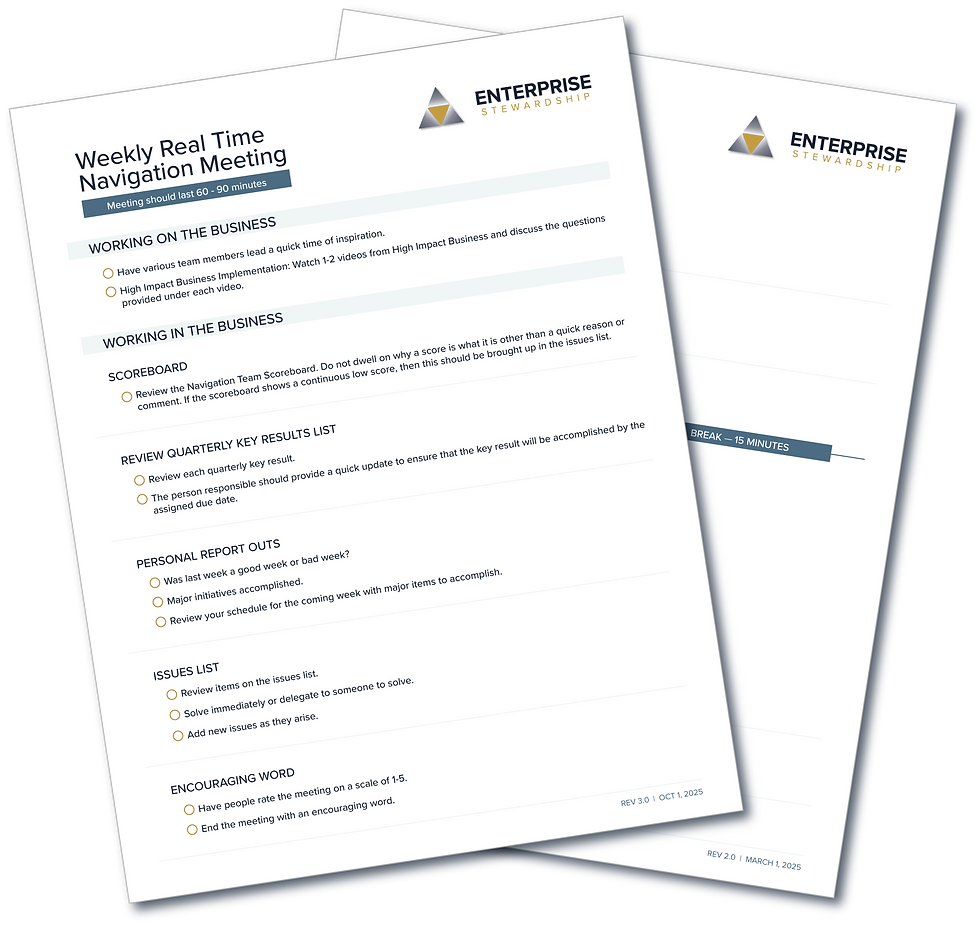
Download Weekly + Quarterly Meeting Tools
Use these free tools to improve leadership meetings, accountability, strategic alignment, and execution.
RealTime Navigation is a Business Execution Framework
At Enterprise Stewardship, we believe RealTime Navigation is more than a meeting structure. It is a practical business execution system for leaders who want to stay on mission while leading in real time.
When storms hit, when priorities shift, and when the unexpected becomes normal, this rhythm helps leadership teams respond with calm clarity. RealTime Navigation helps leaders steer instead of drift, respond instead of react, and multiply alignment, accountability, and action.
If your leadership team is feeling reactive, unclear, or fragmented, the problem may not be a lack of vision. It may be a lack of rhythm.
Take the Next Step: Assess the Health of Your Business Leadership System
A healthy business does not flourish by accident. It flourishes when leaders build the systems, rhythms, and disciplines needed to keep purpose, strategy, culture, and cash aligned.
If you want to understand how well your business is functioning across those critical areas, take the High Impact Business Assessment. It will help you identify where your business is strong, where alignment may be breaking down, and what needs attention next.
By the way... a High Impact Business scores 80% or higher across all four practices inside the assessment. See exactly where your organization stands and what it would take to get there.